Prophets Foretold Him

Tags

, , ,

Of the Father’s Love Begotten.  by Aurelius Clemens Prudentius (348-413), translated by J. M. Neale and H. W. Baker.  From Cantus Christi, pg. 246.

Of the Father’s love begotten
Ere the worlds began to be
He is Alpha and Omega
He the Source, the Ending He
Of the things that are, that have been
And that future years shall see
Evermore and evermore!

At His Word the worlds were framed
He commanded; it was done
Heaven and earth and depths of ocean
In their three-fold order, one
All that grows beneath the shining
Of the moon and burning sun
Evermore and evermore!

Continue reading

All Praise to Thee, Eternal God!

Tags

, , , , , , ,

A hymn by Martin Luther.  From The Lutheran Hymnal of the Evangelical Lutheran Synodical Conference of North America, Concordia Publishing, St. Louis, MO: 1941. #80.

All praise to Thee eternal God
Who, clothed in garb of flesh and blood
Dost take a manger for Thy throne
While worlds on worlds are Thine alone

Once did the skies before Thee bow
A virgin’s arms contain Thee now
While angels, who in Thee rejoice
Now listen for Thine infant voice

Continue reading

A Great And Mighty Wonder

Tags

, , ,

From the Greek of Anatolius, Patriarch of Constantinople and a member of the Ecumenical Council of Chalcedon, A. D. 451.  Translated by Dr. J. Mason Neale, 1862.

A great and mighty wonder
The festal makes secure
The Virgin bears the Infant
With virgin-honor pure.

The Word is made incarnate
And yet remains on high
And cherubim sing anthems
To shepherds from the sky.

Continue reading

Hark, How the Heavens Ring!

Tags

, , , ,

A hymn I’ve selected for the first day of Christmas.

“Hark, How All The Welkin Rings!” is a hymn by Charles Wesley, first published in his Hymns and Sacred Poems in 1739.  It has passed into modern usage as “Hark the Herald Angels Sing.”  While I understand and to varying degrees support the modernization and editing of this hymn that has gone on, I think it’s good to examine the original.  There are some notable changes, so read carefully.

Continue reading

Walther on Faith

Tags

, , ,

I know it’s been a really long time since I blogged about Walther…and I still have my bookmark in Law & Gospel to resume blogging at a later date, but I was reading some things tonight which really struck me on the nature of preaching about faith.

Melanchthon is credited by Walther as being “the father of synergism (that is, synergism within the Lutheran church)” (pg. 289-290, Concordia Pub., 2010 ed.).  He quotes Melanchthon and then offers his rebuttal: Continue reading

Now that the semester has ended…

Tags

, , , , , , ,

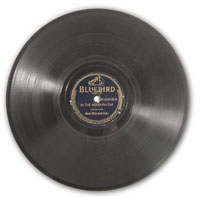
A 10" 78rpm disc

So what do I do now that the semester has finished?  Well, I’ve worked a little, relaxed a lot.  I have quite a collection of old jazz 78s which I’ve been recording to my computer so that I can listen to them on my iPod.  It’s a bit of a time-consuming dubbing process, one which involves sitting and listening to each recording, applying filters so that annoying high-pitched crackle goes away, using one’s ears to make sure it sounds good overall, saving the file, importing to iTunes, creating an mp3 copy, plugging in all the pertinent information, deleting the wave form (and its copy), and repeating the process for the next disc.  But one can’t be in a bad mood and listen to Dixieland (which is most of what I’ve been dubbing lately).

For those who care, I use a Crosley USB turntable which has 3 speeds.  I use an after-market needle to play the 78s because the standard stereo needle which comes with it just doesn’t seem like a great idea to play both 78s and long-playing (45 & 33 1/3) records.

In addition, I’ve gotten some feedback lately from various people who read the blog.  I’ve gotten everything from “I appreciate what God’s doing in your life” to “You need to leave the lifestyle and repent” and everything in between.  My goal is to be the type of man where I would listen to negative feedback and instead of dismissing it, I would consider it carefully to see if anything is valuable from it.  For example, even though I am not in the lifestyle, I do need to live a life of repentance.  Repentance isn’t just the doorway we get through to be reconciled to God…it’s that, for sure…but it’s also the path a Christian treads.

Continue reading

And now, for something completely different…

A good friend sent me a link to this, so I figured I’d repost it. I laughed a lot, as anyone who knows me would guess.

The Semi-Pelagian Narrower Catechism

1. Q: What is the chief end of each individual Christian?
A: Each individual Christian’s chief end is to get saved. This is the first and great commandment.

2. Q: And what is the second great commandment?
A: The second, which is like unto it, is to get as many others saved as he can.

3. Q: What one work is required of thee for thy salvation?
A: It is required of me for my salvation that I make a Decision for Christ, which meaneth to accept Him into my heart to be my personal lord and saviour

4. Q: At what time must thou perform this work?
A: I must perform this work at such time as I have reached the Age of Accountability.

Continue reading

Strategies to Keep from Falling

Tags

, , , , , , , , , ,

What should pastors do to keep their noses clean…or, as we say in the Christian world, themselves pure?  Randy Alcorn has an article which has been highly distributed over the years which I would like to comment on.

In 1989, the book Sins of the Body was published in The Leadership Library, edited by Terry Muck.  It featured articles written by a wide variety of Christian authors.  The article which shares the same name as this blog post, was written by Randy Alcorn.  Christianity Today has the article available on its website here. Recently, some folks asked me what I thought of Randy Alcorn.  It’s been a significant amount of time since I’ve read a book by him, but I wanted to sketch out the apprehension I have for Alcorn using this article as a foil.

My operating assumption is that Randy Alcorn doesn’t understand law and gospel properly and therefore gives rather toxic advice.  Alcorn offers himself as the example instead of Christ and in doing so, contributes to the problem.

Continue reading